Powered by Blogger.

Good Start for the Audi R10 TDI at Sebring

- Fastest lap during the first official practice
- Allan McNish sets fastest time at Sebring
- Record crowd of 150,000 spectators expected


audi r10 Audi has managed a perfect start in this year’s American Le Mans Series (ALMS). During the first official practice day for the season opener at Sebring, the two 650 hp diesel sportscars set the fastest laps on the 5.954 kilometre circuit. The fastest time of the day was set by Audi driver Allan McNish in the #2 Audi R10 TDI during the morning session.

The starting grid for the 12-hour race will be decided in qualifying on Thursday. The organisers expect another record crowd of over 150,000 spectators during the weekend at the traditional season opener in the US state of Florida. The long-distance classic is the most important sportscar race in the USA and for Audi, the dress rehearsal for the 24 Hours of Le Mans where Audi bids to become the first manufacturer to claim overall victory with a diesel sportscar.

Quotes after the first practice day at Sebring

Dr Wolfgang Ullrich (Head of Audi Motorsport): "Like always it’s very difficult to adapt a new car to a tricky circuit like Sebring. We’ve been here for testing but due to the higher ambient temperatures, we now have completely different circumstances. The team is working towards the race set-up for both cars and is making good progress.”

Frank Biela (Audi R10 TDI #1): "We sorted out a few things during testing so that we arrived at Sebring with a good car. Now we have to adapt the Audi R10 TDI to the current conditions and have to deal with circumstances like changing wind direction and force for example. Reacting to these elements was of course much easier with our well known Audi R8. But after the experiences so far, I’m quite optimistic that we will ultimately manage the same with the R10 TDI.”

Emanuele Pirro (Audi R10 TDI #1): "It has been a good start. We have discovered a lot more things about the car and are satisfied with the steps we’ve already made. I’m happy about the positive feedback our diesel project is experiencing in the USA. A lot of enthusiastic fans talked to me and said they couldn’t believe that a diesel can be so fast.”

Marco Werner (Audi R10 TDI #1): "We are very satisfied because now we know that our car is competitive. The encouraging thing is that we have not suffered the slightest problem with our R10 TDI and so was able to work on our programme without interruption.”

Dindo Capello (Audi R10 TDI #2):
"It’s nice to get back into the cockpit of a race car after such a long time of preparation. With the heavy traffic of the slower ALMS classes on the circuit, I feel at home already. We are still improving our R10 TDI and I’m now looking forward to the qualifying.”

Tom Kristensen (Audi R10 TDI #2): "I was looking forward very much to driving the new Audi R10 TDI with diesel power for the first time here at Sebring on Monday and it didn’t disappoint me. Our new ‘baby’ has excellent power and extremely good aerodynamics. So the guys in Ingolstadt and Neckarsulm managed once again to put something very special on four wheels.”

Allan McNish (Audi R10 TDI #2): "Every day we learn more about our car. And now we already know how competitive we are. Our lap times look very good and we are definitely working in the right direction and so will have a well prepared car for the race on Saturday.”

Ralf Jettner (Technical Director, Team Audi Sport North America): "We have worked through our programme without any problems so far. But we also learned that the competition will be very hard here at Sebring. Our competitors Porsche and Dyson are very fast so we can expect a very tough race.”

© Source: original article on fourtitude.com

Read more...

Project B7 A4 2.0T: Introduction

Now in its third generation, the A4 has established itself as a major player in entry-level luxury cars. The A4 range is the most popular sales category for Audi, and the A4 2.0T is a relatively affordable and very capable entry-level offering. With all of this in mind, we believed it time to launch another project car series – Project B7 A4 2.0T.

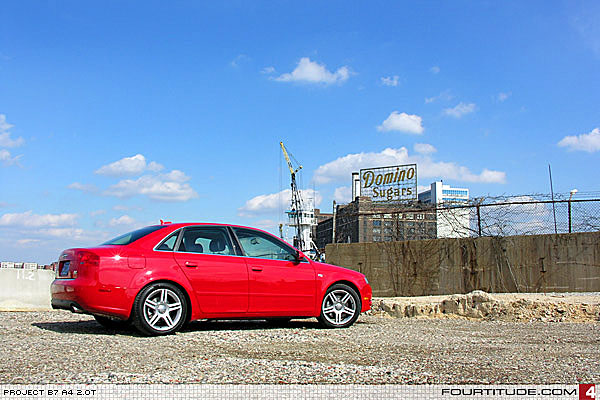
audi a4audi a4 2audi a4 3 Better yet, we thought it perhaps a timely move to team up with a well-known contributor to various Audi forums. Zerin Dube is not new to Audis, having built a pretty spectacular B5 S4. Zerin recently acquired a B7 and we were certain he’d do things that were just as impressive, if not moreso, with this new red sedan.

Working together with Zerin, Fourtitude plans to explore the burgeoning new market out there now for the B7 A4 and the 2.0T engine. The B7 may appear similar to the B6, but many components such as suspension have been changed. This project will help put a spotlight on products for this new generation A4, and try some new modifications that haven’t yet been done before.

Look for regular updates on our new Project B7 A4 2.0T regularly on the site, and expect to see the red sedan in the Fourtitude booth at some shows this summer, or on display at other events where Fourtitude is not there in an official capacity. For now, we’ll hand the pen over to Zerin so that he can introduce himself…

Audi Background: Zerin Dube

I first fell in love with the Audi brand in 1999 when I saw an ad for the then new Audi S4. The ad depicted a yellow S4 in motion amidst a blurred background. From that very moment, the Audi S4 became my realistic dream car. It had everything I ever wanted in a car…lots of power, great looks, impressive handling and the convenience of a four-door. On top of that, the car had the tuning potential to be converted from a mild-mannered Dr. Jekyll sports sedan to an Mr. Hyde-like high-horsepower monster - all the while retaining its benign appearance.

A year later, a yellow S4 happened to be parked on a pedestal in front of my local Audi dealer as I drove by it on the freeway. Seeing it there in person, I lost any ability to think rationally, exited the freeway and went to the dealer to check out the car that I had lusted over since I first laid eyes on it in that ad. A few hours later, in what was probably the biggest impulse buy of my life, I left the dealership the proud new owner of that yellow S4. My dream had come true, and my love affair with the Audi brand had begun.

A friend of mine at the time asked me what I had planned as far as modifications. I looked at him as if he was crazy and said “I just spent $40,000 on a car, no way I’m ever doing a single modification to this car.” Of course, like many of us who bought the B5 S4, the story hardly ended there. Two years later, my S4 was pumping out 400+ horsepower, had 1200 watts of audio gear, and had even landed on the pages of a few tuner magazines.

I regrettably had to sell that S4 in 2002 when the IT market started to tumble, and I felt like I was losing a part of me. It’s not the car that made me who I was, but it was the emotion I felt when I looked at it and drove it. No other car came close to the visceral rush the S4 gave me when behind the wheel. I vowed that I would own another Audi again, and try to pick up where I left off with the S4. I just didn’t know when that would be.

Then it hit me. I spotted it in the Audi stand while attending the 2005 Detroit Auto Show. There, on display, was a red 2005.5 B7 Audi A4. This was the first time I had seen one in person, and it was quite simply love at first sight. The car had grown up since the B6; the aggressiveness and edginess of the B5 had returned.

The 2.0-liter Turbo FSI powerplant I had read so many good things about was equally as enticing. The B7 A4 had the same traits that made me fall in love with the B5 S4: plenty of power, great looks, great handling, and most importantly, great potential. The car was just perfect in almost every way. It was at that very moment that I decided I had to have one.

I took delivery of my first B7 A4 2.0T Quattro in early April of 2005. I felt right at home in the familiar interior of the A4. It drove beautifully, the engine was phenomenal, and the design was stunning. It was almost as if the car was saying to me “Welcome Back.” There was just one problem though, and a pretty big one at that…the color.

When I had my dealer locate a car based on the options I wanted, the only car they could come up with was silver. Silver was the absolute last color I wanted to buy, and would have preferred almost anything else over silver…but it was all that was available at the time in my region. I had no time to wait on other colors to become available, as I had a buyer flying into town the very next week to buy my previous car, a VW GTI. I sucked it up, tried to convince myself silver was what I wanted, and bought the A4 from Millennium Audi in Houston.

Over the next few days, I started to visualize my modification plans. I knew what I wanted to achieve, but had to figure out exactly how I was going to achieve it. The color of the car again became a problem. I just could not get excited about silver. Honestly, the car looked great, but the color just was not anything to turn heads with. I started to have a bout of buyer’s remorse when I got a call that would change my entire attitude about the project.

One of the other dealers in Houston was forced to return inventory to port, and a Brilliant Red A4 2.0T with all the options I wanted had become available. Better yet, Millennium Audi made my situation that much easier, allowing me to switch out of the silver car and into the red one for no other cost than the additional cost of options in the red one. I was now the proud owner of a Brilliant Red A4 2.0T quattro 6-speed with sport package, premium package, BOSE, and lighting packages. Now I felt complete. I had a color I wanted all along, and a car I was totally in love with for the first time since selling my S4. I was finally ready to start Project B7 A4 2.0T, and ready to start big.

The Plan

My philosophy of modifying a car differs from some enthusiasts. I value practicality over insanity and subtlety over in-your-face attention-getting looks. I also look at the big picture from start to finish when building a car.

All parts, no matter how small, will have an impact on the end result. All parts and changes have to be cohesive, well engineered and well thought out. I will not sacrifice daily drivability for performance. I will not sacrifice quality for cost savings. I will not put anything on the car that has a detrimental effect on anything, just because it “looks cool” or makes “cool noises”. I will not put parts on the car just to make my modification list longer. All aesthetic modifications have to be in good taste, and should be of OEM-quality fitment. That is my philosophy, and it follows the “keep it simple” mentality. Simple doesn’t have to mean boring, and my Project B7 A4 2.0T will reflect that.

The project will be primarily focused on performance, but will also highlight electronics integration and visual enhancements. I’ll begin byfocusing on how simple computer tuning can transform the stock 2.0T B7 A4 into a car that feels as if it had twice as many cylinders and then look at the difference a properly set-up suspension can make on a car, versus slapping in some off-the-shelf struts and springs . I’m planning subtle design changes that, when combined together, change the entire look of the car. Hopefully, I’ll do all of this on a budget, without sacrificing practicality or reliability. This should be a project car that everyone will be able to relate to.

© Source: original article on fourtitude.com

Read more...

2006 Renault Altica Concept

Altica is a sporty estate that combines flowing lines with a spacious interior. Its dynamic stance is underpinned by a long bonnet and curved forms, while its modular interior ensures outstanding load capacity.

2006 renault altica2006 renault altica 22006 renault altica 32006 renault altica 42006 renault altica 5 Altica stands out as a dynamic vision of the estate, combining the practicality of the latter, the sports appeal of a coupй and a high standard of travelling

Flowing, sporty lines

The panoramic windscreen and rear window underline the car’s fluid aerodynamics. The two-tone paintwork accentuates the side design and also asserts Altica’s graphic identity. The car’s overall stance – low-slung lines, long bonnet, prominent wings – and proportions express true sports car dynamics. Comprised of a mosaic of transparent panes, the rear quarter lights suggest forward movement.

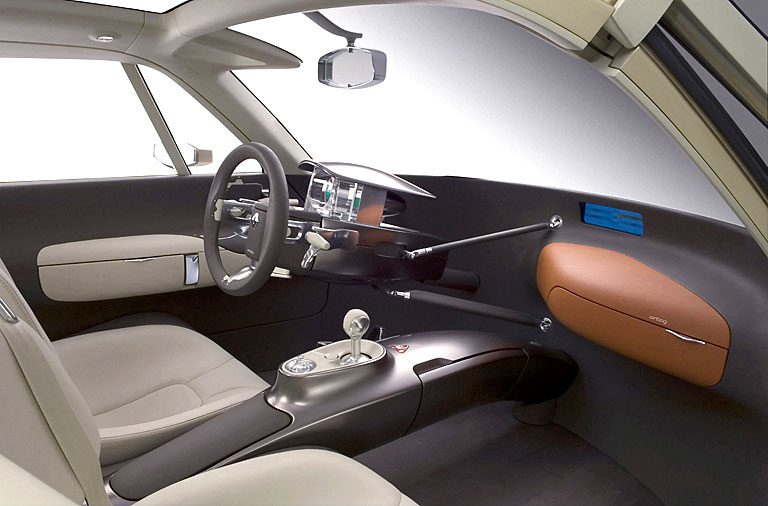
Altica’s interior mirrors its sporty, dynamic exterior design. The suspended drive station is held in place by four profiled rods that hint at the world of Formula 1.
The transparent roof and panoramic windscreen erase the boundary between the interior and the outside world and also ensure a brightly-lit cabin. The mosaic design of the rear quarter lights allows sunlight to filter into the cabin much like it does through stained glass windows and gives the interior a more welcoming feel. The layout and angling of the panes ensure good three-quarter rear visibility for the driver which is indispensable when parking.

The headlamps feature four different modes – daytime running lights (DRL), sidelights, dipped beam and main beam – and function using rows of diodes. They also produce a halo effect when the DRL mode is selected. This is achieved in two ways. First of all, each polycarbonate headlamp module cover is speckled with thousands of small, micro-engraved nicks.
Invisible to the naked eye, these nicks have no effect on the beams and permit light to pass unhindered. In the daytime running mode, however, the surface of the module cover is illuminated from the edge. The light is accordingly trapped inside the mass and spreads out like a fluid over the entire surface to produce an original and effective halo effect for the DRL and sidelight functions.

An estate with the accent on practicality

Altica’s sports pedigree is reinforced by its scissor doors, the form of which ensures easy access to this low vehicle. The generous interior volumes of Altica provide a very high standard of travelling comfort despite the car’s sporty characteristics. Each of the four individual seats boasts outstanding comfort.

Instead of the seats, which are fixed, it is the drive station and pedal assembly that adjust to match the driver’s physique thanks to a motorized mechanism.
The height-adjustable centre armrest deploys automatically as the driver sits down.
The vertical positioning of the dashboard takes its inspiration from the world of aeronautics and permits the driver to feel at one with the car.

The centrally-positioned dial features two display modes: “comfort” and “sport”. The “comfort” mode
indicates the car’s speed in the centre of the display while the perimeter shows the legal speed limits
which turn red if exceeded. In the “sport” mode, the speed continues to be displayed in the middle of the dial but the perimeter becomes a digital rev counter and turbo pressure indicator. The graphics of the high-resolution screen provide a distinctly human touch to this high-tech display which itself suggests watchmaker-like precision and sophistication.

Driving pleasure, power and control

Altica is a dynamic sporty estate that combines driving pleasure with a sensation of power and control. With its long bonnet, sports dimensions (length: 4.27m; width: 1.83m) and very low centre of gravity, Altica offers remarkable performance. Altica’s new 177hp 2.0 dCi particulate filterequipped diesel engine takes the car from a standing start to 100kph in just 7.5s.

Coupled with a six-speed Altica features a number of clever storage spaces, including the shell-like glove box, concertina-style storage compartment in the armrests and a tray situated underneath the floor at the rear. The rear seat backs can be folded into the flat floor which is equipped with straps that permit heavy or bulky loads to be held secure. This layout transforms Altica into a two-seater sports coupй with a vast 1,300-litre boot, while the boot lid provides very easy access and an extremely low loading sill. Altica’s low fuel consumption also stems from its exceptional aerodynamics.

Located at the extremity of the roof at the point where the vehicle and the passing air flow separate, a discreet mechanical system generates jets of air which are alternately blown and sucked through a 2mm wide slit. Known as “Synthetic Jet”, the system actively controls the separation of the air flow
according to the vehicle’s speed. This innovative technique, which reduces drag and controls the structure of the air flow, is a registered Renault patent and reduces the car’s Cd at 130kph by 15% for an energy consumption of just 10 Watts. gearbox, this powerplant – which boasts maximum torque of 380Nm – provides excellent pull-away and mid-range acceleration. This hasn’t been achieved
to the detriment of fuel consumption, however. The Renault-Nissan Alliance engine is very inexpensive to run and fuel consumption is equivalent to 140g of CO2 per kilometre. In terms of both performance and driving pleasure, it stands out as the best diesel engine in its class.

Valeo

Altica’s lights employ high-performance light emitting diodes (LEDs). The dipped and main beam functions are housed in a single module which tops a linear directional light. The LED control unit permanently adapts the quantity and orientation of the beam as a function of the conditions. During motorway driving, the LEDs that ensure long range visibility are automatically activated and controlled to guarantee optimum visibility at all times without dazzle. The colour of the light emitted by the LEDs is similar to that of daylight for enhanced optical comfort and visibility.

The daytime running light (DRL) mode, which is activated most of the time while the car is moving, also use LEDs. Their high efficiency and the low amount of energy they require significantly reduce the power that is consumed compared with a conventional light source. The life expectancy of LEDs is also much longer than that of all contemporary light sources. As a world first, the sidelight function is ensured by a veil of light that covers the entire headlamp thanks to Valeo’s exclusive MicroOptique technology.

TECHNICAL CHARACTERISTICS

Dimensions
Overall length 4,270mm
Width (excluding door mirrors) 1,830mm
Height 1,360mm
Wheelbase 2,620mm
Front and rear track 1,540mm
Front overhang 936mm
Rear overhang 714mm
Ground clearance 175mm
Weight 1,300kg

Powertrain
Four-cylinder 2.0-litre 16-valve turbocharged Euro 4-compliant dCi diesel engine with balancer shafts
and particulate filter.
Power: 130kW / 177hp and maximum torque of 380Nm at 2,000rpm
Standing start to 100kph in 7.5 seconds
Maximum CO2 emissions:140g/km, for a standard cycle fuel consumption of 5.3l/100km
Six-speed manual gearbox

Transmission
Front-wheel drive, front,
transverse-mounted engine
21-inch wheels 245 / 35 - ZR21 tyres

Partners
Valeo Exclusive MicroOptique technology: micro-engraved module cover for the daylight running light (DRL) and sidelight functions
Lighting and signal functions using high-performance LEDs
Michelin Pilot Sport 2 tyres
Montupet Specifalloy wheels ic light

Exterior equipment

• Active Synthetic Jet system located at the rear edge of the roof reduces drag at 130kph by 15%
• Two scissor doors activated by optical sensors
• Panoramic windscreen and transparent roof
• Mosaic rear quarter lights optimize 3/4 rear visibility
• Wide boot lid opening and very low loading sill (located 450mm from the ground)

Interior equipment

• Four independent seats; the two rear seats can be folded down to obtain a boot storage volume of up to 1,300 litres
• Drive station suspended by four rods
• Motorized adjustment of pedal assembly and steering wheel positions
• The steering wheel and pedal assembly move automatically clear when the door opens; automatically deploying centre armrest
• Analogue and digital centrally-positioned instrument with two display modes: “sport” and “comfort”
• Additional storage space underneath the rear parcel shelf of the boot floo

© Source: original article on seriouswheels.com

Read more...

  © Blogger templates Newspaper by Ourblogtemplates.com 2008

Back to TOP